The Journal · Buying Guide
How to Choose the Right Professional Hairdressing Scissors
Length, edge, handle and steel — the four decisions that separate a shear you tolerate from one you never want to put down. A straight-talking guide from our bench in Belfast.

Most stylists choose their scissors the way they choose a pen — whatever’s to hand, whatever the wholesaler had in stock. Then they spend ten years cutting around it. Here’s how to choose the other way round: start with the way you cut, and let the shear follow.
The short answer
Pick your length by the sections you cut most, your edge by your technique, your handle by how your arm feels at the end of a Saturday, and your steel by how long you want that edge to last between services. Get those four right and the shear disappears in your hand — which is exactly the point.
1. Length: match it to your sections
Length is measured from the tip of the blade to the end of the finger ring (not including the finger rest). Shorter shears give you control at the detail; longer shears carry a straight line through a wide section in one pass.
| Length | What it’s best at | From our range |
|---|---|---|
| 5.0″ | Detailing, blunt perimeters, work around the ear and neckline | The Soto |
| 5.5″ | Wet cutting, point cutting, precision — the most versatile first shear | Erikson, Hillary, Polo, Master Precision, Foundation |
| 6.0″ | All-round cutting, layers, a little scissor-over-comb | Dias, Pizarro, Master Craft |
| 6.5″ | Longer sections, dry cutting, strong lines | Dias, Master Craft |
| 7.0″ | Scissor-over-comb, one-length perimeters, big sections | The Columbus, Master Craft |
A quick test: hold the shear with your fingers in the rings and rest the blade along your palm. If the tip reaches roughly the middle of your fingers, you’re in the right range for everyday work. Anything much longer, and your detail work will start to feel like parking a lorry.
2. Edge: how the blade meets the hair
This is the decision most people never knowingly make — and it changes the finish more than anything else.
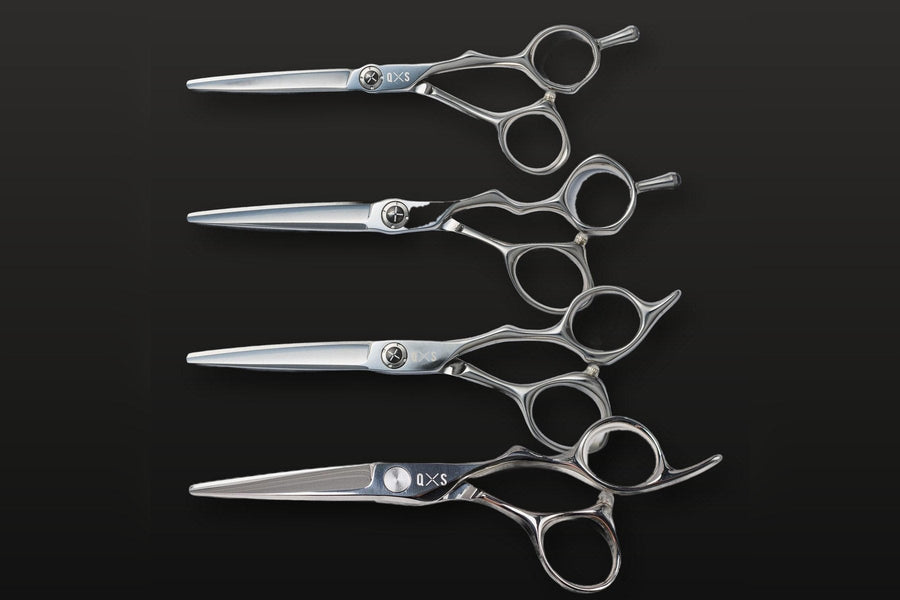
- Full convex — the finest, most razor-like edge. It lets hair slide slightly before it’s cut, which gives a softer end and makes slide cutting and slicing possible. It’s the edge on most of our X Series.
- Semi-convex — a touch more bite. It holds the hair a little more firmly, which suits blunt lines and clean perimeters. You’ll find it on The Soto, Pizarro Noire and the Master Precision Matt Gold.
- Bevel — a steeper edge that grips the hair and cuts it straight across. Brilliant for scissor-over-comb, hopeless for slicing.
If you slide cut, you need convex. If you mostly cut blunt, you can have a little more bite. Nobody needs one shear that does everything badly.
3. Handle: the decision your shoulder makes
Watch your elbow while you cut. If it lifts every time you close the blades, your handle is fighting you — and over a career, that adds up in the wrist, the elbow and the shoulder.
- Offset — the thumb ring sits shorter than the finger ring, so your thumb and elbow drop into a natural position. The right default for most stylists, and the shape of most of our range.
- Classic zero-offset — symmetrical, traditional, precise. Great for barbers who open and close the blade from the thumb, like on The Soto.
- Swivel — the thumb ring rotates, so your elbow stays down even when you cut vertically or at awkward angles. It’s the biggest comfort upgrade you can make, and it’s why we built the Polo, Dias and Vasco Swivels.
Want the long version? Read Offset vs. Crane vs. Straight Handle Scissors.
4. Steel: how long the edge lasts
Sharpness out of the box is easy. Keeping it is the hard part — and that’s the steel’s job. We state the steel on every shear we make, and we’d suggest you never buy one that doesn’t.
| Series | Steel | Hardness | Who it’s for |
|---|---|---|---|
| Foundation | 440C stainless | 58 HRC | Trainees, second pairs, anyone who wants professional steel at an honest price |
| Master | VG10 | 59 HRC | Full-column stylists who want refined comfort and a longer-lasting edge |
| X Series | AG-16 Cobalt Alloy | — | Our flagship — every model shaped around a specific technique |
HRC is Rockwell hardness. The higher the number, the longer a fine edge holds — though harder steel also asks for a skilled sharpener. More in What is 440C Steel?
5. Build the kit, not just the shear
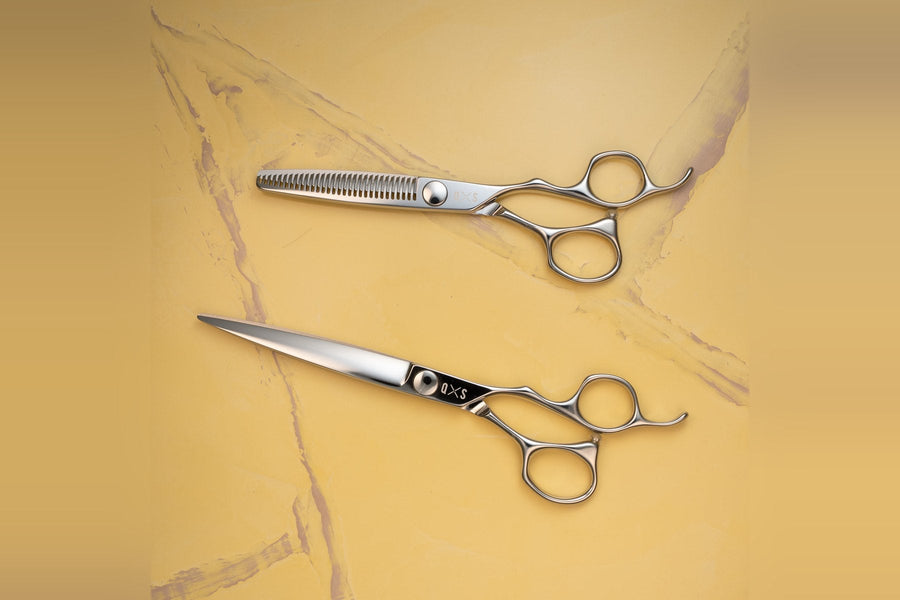
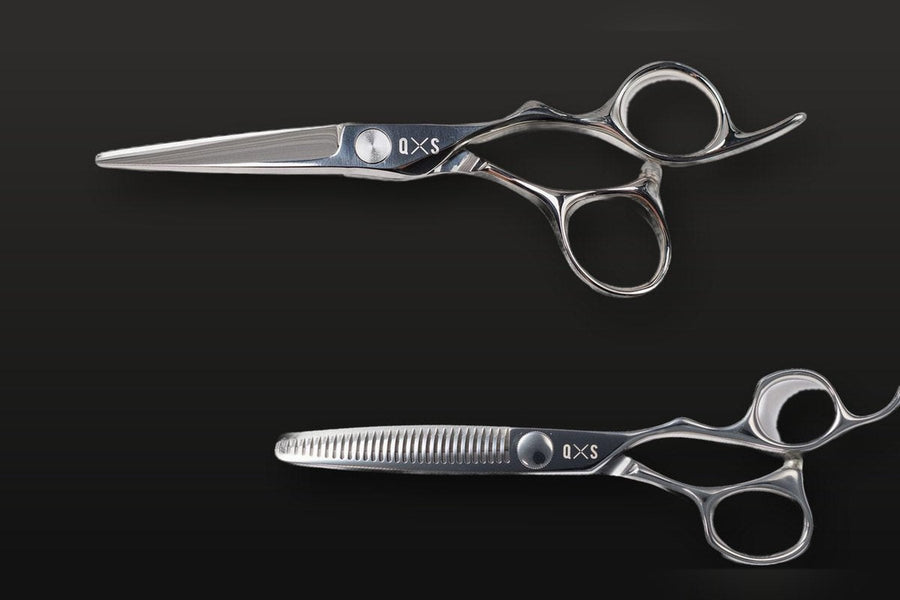
Almost every cut uses more than one tool. The minimum working kit is a cutting shear plus a thinner or blender; the kit most full-time stylists end up with is three — a main cutter, a detail or slicing shear, and a texturiser. (I explain why in Why You Should Own Three Pairs.) Our Bundles & Kits pair shears that are made to work together.
Find your shear in 30 seconds
| If you mostly… | Start with |
|---|---|
| Cut scissor-over-comb and long sections | Columbus 7.0″ · Master Craft |
| Detail and cut blunt perimeters | Soto 5.0″ · Erikson 5.5″ |
| Wet cut, every day, all day | Hillary or Polo, 5.5″ or 6.0″ |
| Dry cut and want strong lines | Dias 6.0″–6.5″ |
| Slide cut and slice | The Vasco |
| Want texture without the line | Vespucci · 303 Thinner · Foundation Thinner |
| Are just starting out | The Foundation Duo |
Questions we get asked
Is a more expensive shear always better?
No. A better-matched shear is always better. A £300 shear in the wrong length and edge will cut worse for you than a well-chosen Foundation.
Do you make left-handed shears?
Yes — most of our cutters and thinners are available left-handed. Look for the left-hand option on each product page.
How long should a professional shear last?
With daily wiping, a drop of oil and a professional service around every six months, a well-made shear lasts for years. Every Quartered Steels pair carries a lifetime warranty on parts.
Reply to any of our emails with a question — it comes straight to me.
Dan Wild · Founder, Quartered Steels · Belfast