The Journal · Buying Guide
Offset vs. Crane vs. Straight Handle Scissors — Which Should You Choose?
Your handle decides where your elbow lives for the next twenty years. Straight, offset, crane and swivel explained — with the one-minute mirror test that tells you which is yours.

Blade, steel, length — we obsess over all of them. Then we hand the job of protecting our wrists, elbows and shoulders to whatever handle happened to come attached. Of all the decisions in a shear, this is the one your body will remember.
The short answer
An offset handle suits most stylists and is the safest default. A crane drops the elbow further for people who cut with their arm raised a lot. A straight (zero-offset) handle suits barbers and stylists who drive the blade from the thumb. A swivel goes furthest of all: the thumb ring rotates, so your elbow stays down at any angle.
The mirror test
Stand in front of a mirror, hold your current shear and cut an imaginary vertical section at head height. Watch your elbow. If it rises towards your shoulder every time you close the blades, the handle is making you lift your whole arm to do a job your thumb should be doing. That’s thousands of lifts a week.
The four handle types
| Handle | How it’s built | What it does for you | Suits |
|---|---|---|---|
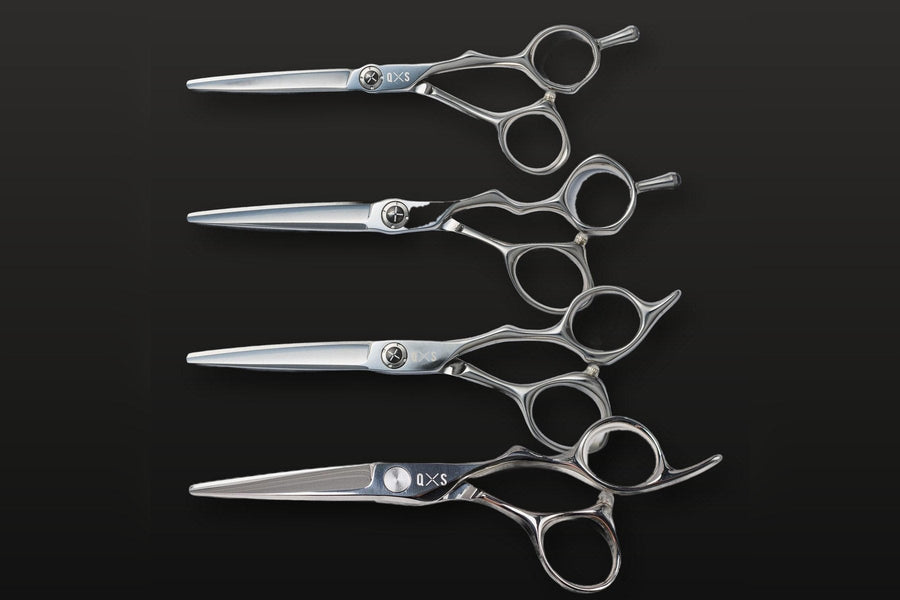
| Straight / zero-offset | Thumb and finger shanks the same length, rings in line | Symmetrical, precise, traditional feel | Barbers, thumb-driven cutters, blunt perimeters |
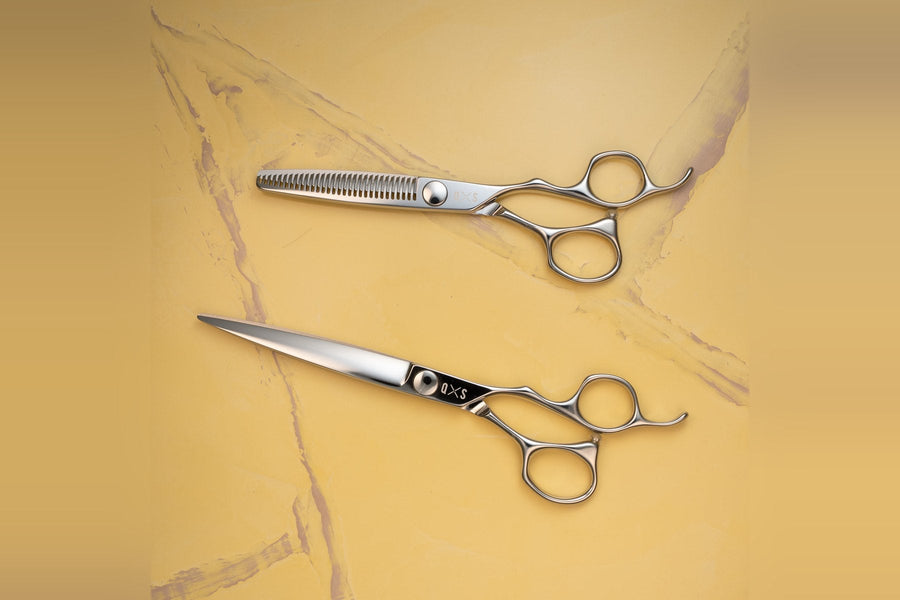
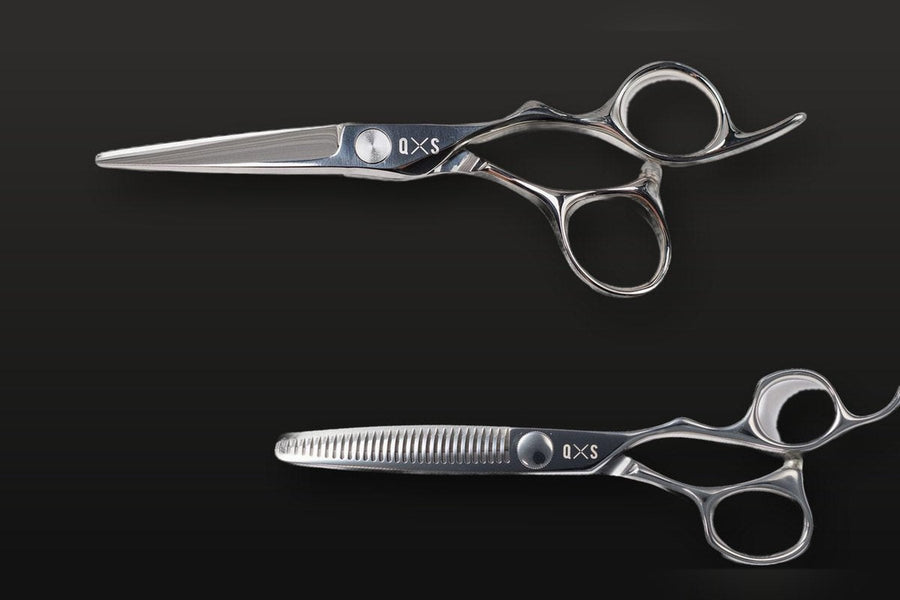
| Offset | Thumb shank shorter than the finger shank | Drops the thumb and elbow into a natural, relaxed position | Most stylists, most days |
| Crane | An offset with the blade angled up from the handle | Drops the elbow further still | Stylists who cut with the arm raised |
| Swivel | Offset with a rotating thumb ring | Lets the thumb move independently, so the elbow stays down at any angle | Long days, vertical cutting, anyone with wrist or shoulder niggles |
Straight (classic zero-offset)
The original shape. With both rings level, the blade opens and closes from the thumb in a clean, symmetrical movement — which is why many barbers love it for detail and perimeter work. The trade-off is posture: to cut at an angle, the elbow has to come up. The Soto is our classic zero-offset shear.
Offset
The modern default and the shape of most of our range. Shortening the thumb side lets the thumb sit lower, so the elbow can stay closer to the body. From the refined Master Precision to the sculpted Hillary and the modern classic Polo, offset is where most stylists should start.
Crane
A crane takes the offset idea further by angling the blade up from the handle, so the hand and elbow can sit lower still. It suits some stylists beautifully and feels awkward to others. We don’t currently make a crane — for the problem it’s trying to solve, we think a swivel does the job better.
Swivel
A swivel lets the thumb ring rotate independently of the blade. Your thumb can find its natural angle whatever the section, so your elbow stays down whether you’re cutting horizontally, vertically or around the ear. It takes a week or two to trust; after that, most people never go back.
We make three: the Polo Swivel for all-day everyday cutting, the Dias Swivel for dry cutting and strong lines, and the Vasco Swivel for slide cutting and slicing.
Your thumb ring rotates, your elbow drops, your wrist thanks you. It’s the single biggest comfort upgrade in the whole kit.
Small details that matter as much as the shape
- Finger ring size. Rings that are too big make the shear rock in the hand. The Pizarro uses smaller finger rings for a closer, more secure fit.
- Thumb comfort. Contoured or padded thumb rings, like the extended comfort pad on The Dias, spread the pressure on long days.
- Removable tang. The finger rest on the Foundation and Vespucci can be removed if you prefer a cleaner hold.
- Tension. Too tight and you’re working harder than you need to on every close. Check it weekly — see our care routine.
Questions we get asked
Is an offset handle good for beginners?
Yes. It’s the most natural transition from whatever you trained on, and it builds good posture habits from day one.
How long does it take to get used to a swivel?
Most people feel at home within a week or two of daily use. Start on straightforward cuts and let your thumb learn the movement.
Can a new handle fix wrist or shoulder pain?
A better handle reduces strain, but it isn’t a medical treatment. If you have ongoing pain, speak to a medical professional.
Dan Wild · Founder, Quartered Steels · Belfast