The Journal · Care & Edge
How to Clean and Maintain Your Professional Scissors
Thirty seconds after every client, one drop of oil a day, a two-minute check each week. The care routine that keeps a professional shear cutting like new for years.

A professional shear is a precision instrument that lives in a wet, product-heavy, occasionally chaotic environment. It asks for very little in return for years of work — about two minutes a day. Here’s the routine we’d give every stylist and barber on their first day.
The short answer
Wipe after every client. Oil the pivot at the end of every day. Check the tension once a week. Store them closed, dry and in a case. Service them at least every six months.
The routine at a glance
| When | What | Time |
|---|---|---|
| After every client | Wipe both blades clean and dry | 30 seconds |
| End of every day | One drop of scissor oil in the pivot | 1 minute |
| Once a week | Deeper clean and tension check | 2 minutes |
| Every six months | Professional service | We do this bit |
After every client: wipe
Hair, water, product and natural oils coat the blades with every cut. Left there, they cause drag and, over time, corrosion on the edge.
- Open the shear fully and wipe each blade with a soft, dry cloth, moving from the pivot out towards the tip.
- Never drag the cloth across the cutting edge — you’ll snag the cloth and eventually the edge.
- Get into the area around the pivot, where product loves to collect.
End of the day: oil
The pivot is the heart of the shear. A little oil keeps the action smooth, keeps grit moving out rather than in, and protects the bearing surfaces.
- Open the blades to a V and put one small drop of scissor oil where they meet at the pivot.
- Open and close several times to work it through.
- Wipe off any excess from the blades.
Use proper scissor oil. Household lubricants and sprays aren’t designed for this and can leave residue behind.
Once a week: clean deeper, then check the tension
Wipe the blades with a soft cloth and a little isopropyl alcohol to lift stubborn product, dry them thoroughly, then re-oil the pivot.
Now the tension. Hold the shear vertically by the finger ring, lift the thumb blade to fully open and let it fall. It should drop smoothly and stop roughly a quarter to a third of the way closed.
- Closes all the way: too loose. Hair will fold and push out of the blades.
- Barely moves: too tight. You’ll wear the blades faster and tire your hand.
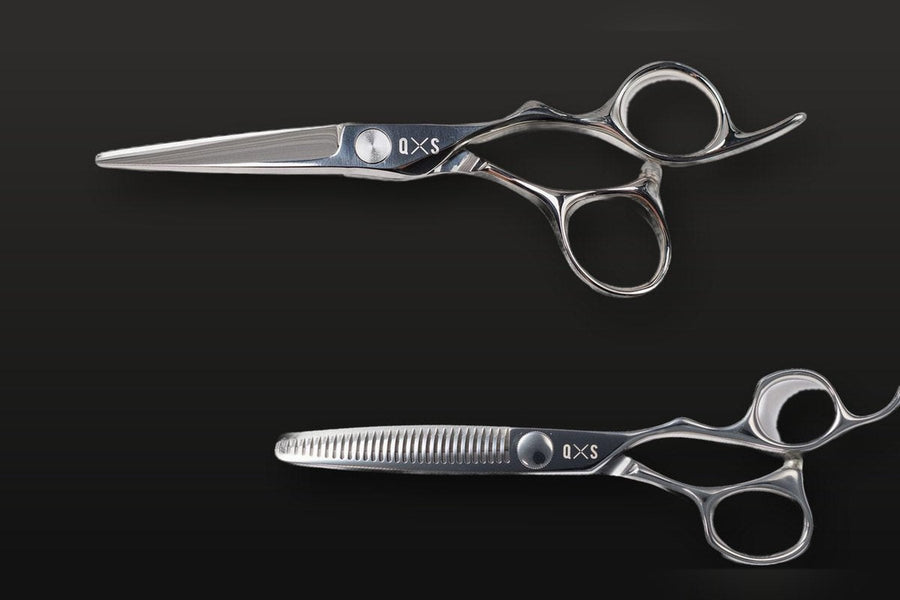
Every Quartered Steels shear uses a ball-bearing tension system. On the Foundation Series and the 303 Thinner, the tension is hand-adjustable — no key needed. Across the X Series and the Master Precision, a low-profile keyed system holds your setting securely until you choose to change it.
Most shears that “stopped cutting” are just loose. Check the tension before you blame the edge.
Storage: protect the edge
- Always close the blades before you put a shear down or away.
- Keep them in a case or pouch, never loose in a drawer, trolley or bag.
- Keep them dry. Never leave shears soaking in barbicide overnight.
- If one falls, check the tips and the action before your next client. A drop can knock the blades out of alignment.
Every six months: a professional service
Even perfect care won’t stop an edge wearing. Our Scissor Sharpening service strips, inspects, sharpens, resets and tests any brand of shear, with at least 45 minutes on every pair. More on timing in How Often Should You Sharpen Your Scissors?
Questions we get asked
Can I disinfect my shears?
Yes — wipe them with an appropriate disinfectant or alcohol, then dry and oil them. Just don’t leave them submerged.
What oil should I use?
A dedicated scissor oil. It’s light, clean and made for exactly this job.
Does looking after them affect the warranty?
Our lifetime warranty covers parts. It doesn’t cover wear or damage from use — which is one more reason the routine above is worth two minutes a day.
Dan Wild · Founder, Quartered Steels · Belfast